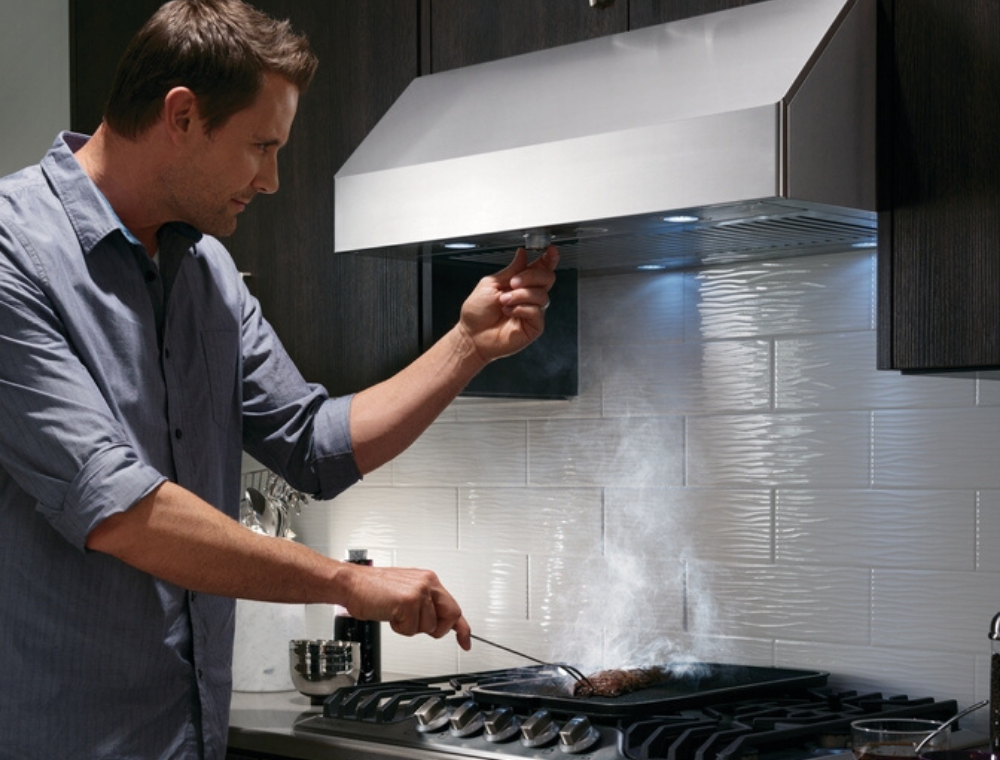
Range hoods are more than just a pretty kitchen feature. They’re an essential component of a healthy home environment. Without proper ventilation, grease and odours can affect you and your home in ways such as:
- Grease and odours can expose you and your family to mold, mildew, and bacteria build-up in unwanted places
- Airborne particles are increased
- Grease, unpleasant odours, and smoke can also absorb into cabinets, walls, and soft surfaces such as draperies, carpet, etc.
- If excess moisture can’t escape, it can cause a warm and sticky kitchen. This can cause potential moisture damage to walls and ceilings
- Grease can attract unwanted critters
As you can see, having a good range hood is the solution for maintaining good air quality in your home.
Here are 5 common range hood types:
- Wall Chimney Hood: this range hood is installed on the wall when there are no cabinets above the cooking surface
- Undercabinet: this type is mounted to the bottom of the cabinet that’s directly over the cooking surface
- Island: attached to the ceiling over the cooking surface that sits on an island (or peninsula)
- Over-the-Range Microwave: a microwave range hood combination that mounts underneath a cabinet
- Downdraft: this option sits beside or behind the stovetop and sucks air down the duct that runs under the floor. It can be retracted when not in use
Most styles come vented or unvented. Vented range hoods are attached to a duct that moves grease and odours outside. Unvented (or ductless) uses a filter to clean the air, then recirculates it back into the kitchen.
Vented range hoods are far superior, but sometimes unvented hoods are the only option because of the layout of the kitchen. Just remember, having an unvented range hood is better than having nothing at all!
Depending on the layout and size of your kitchen, the type of cooking you do, and what type of cooking surface you have, here are a few things to consider:
- Size: the range hood needs to cover the entire area of the cooking surface underneath it
- Noise level: although there’s no such thing as a quiet range hood, some are quieter than others
- CFM (cubic feet per minute): It’s the measure of how long it takes the air in the room to pass through the range hood. A large kitchen or professional range will need a more powerful fan.
- Filters: take a look at what type of filter it has, and how it needs to be cleaned or replaced
- Features: there are many cool features on range hoods these days, like adjustable fan speeds and lighting levels
Creating a healthy home environment is important for not only you and your family but for your home as well! Our expert sales team is always here to help you find the perfect range hood for your needs!
For more inspiration, visit us on Instagram, Facebook, Twitter, Pinterest, or YouTube!